Hardness compounds predominantly calcium and magnesium salts collect on heat transfer.
Boiler water hardness limit.
General guidelines to prevent corrosion and scaling in low pressure boilers are as follows.
This can be written as.
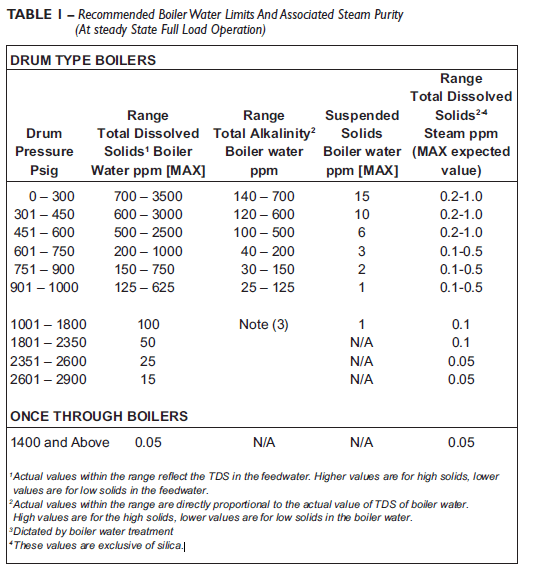
The purity requirements for any feed water depend on how much feed water is used as well as what the particular boiler design pressure heat transfer rate.
A serious loss of boiler efficiency and possibly boiler failure.
In treated waters alkalinity may also be contributed by hydroxide phosphate silicate and.
In order for this reaction to take place it is important to maintain a ph at a minimum value of 9 50.
Alkalinity test in natural waters alkalinity is most commonly the result of bicarbonate and carbonate ions.
Deposition from low less than 1 0 ppm hardness boiler feedwater is eliminated with chelant programs and can be reduced by up to 95 by a good polymer phosphate treatment program.
Feed water boiler water characteristics as per is 10392 1982 1 feed water parameters upto 20 kg cm2 21 kg cm2 to 39 kg cm2 40 kg cm2 to 59 kg cm2 unit total hardness 10 1 0 0 5 ppm as caco 3 ph value 8 5 9 5 8 5 9 5 8 5 9 5 dissolved oxygen.
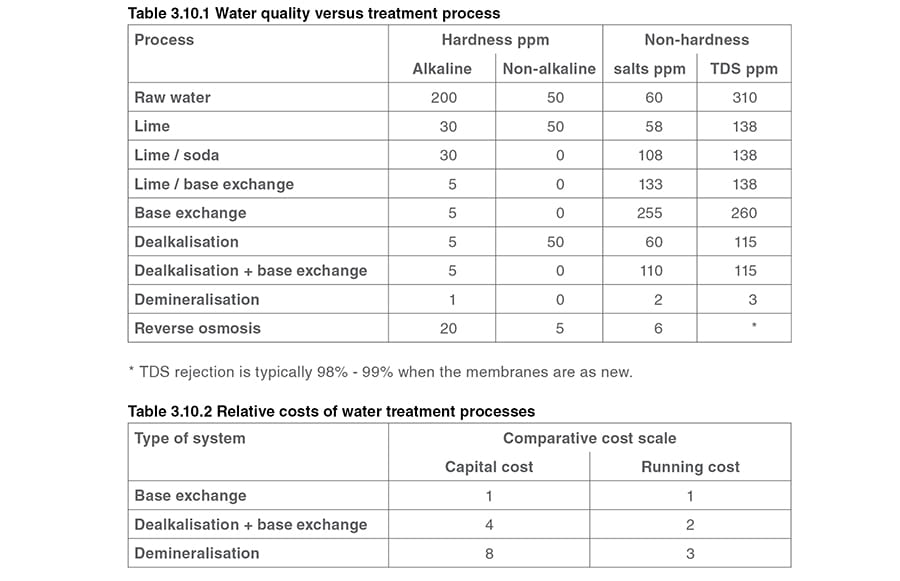
Small amounts of hardness and iron can get into the boiler.
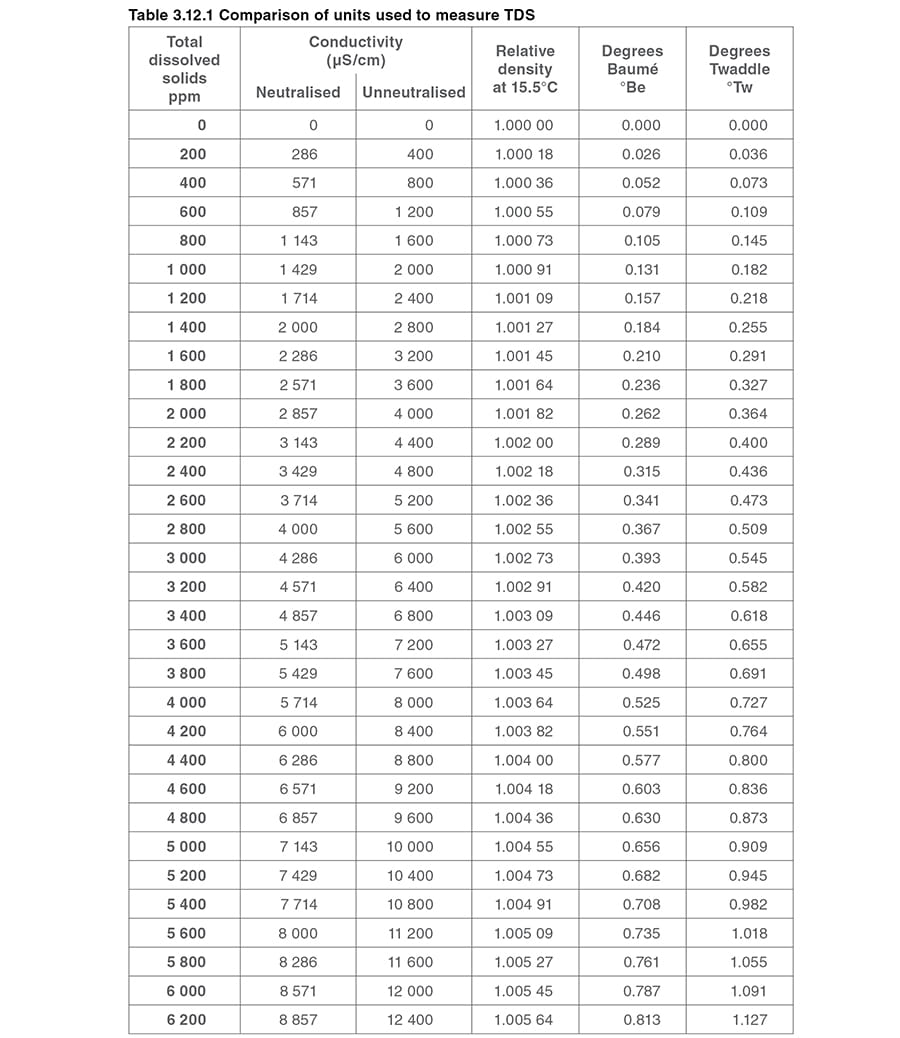
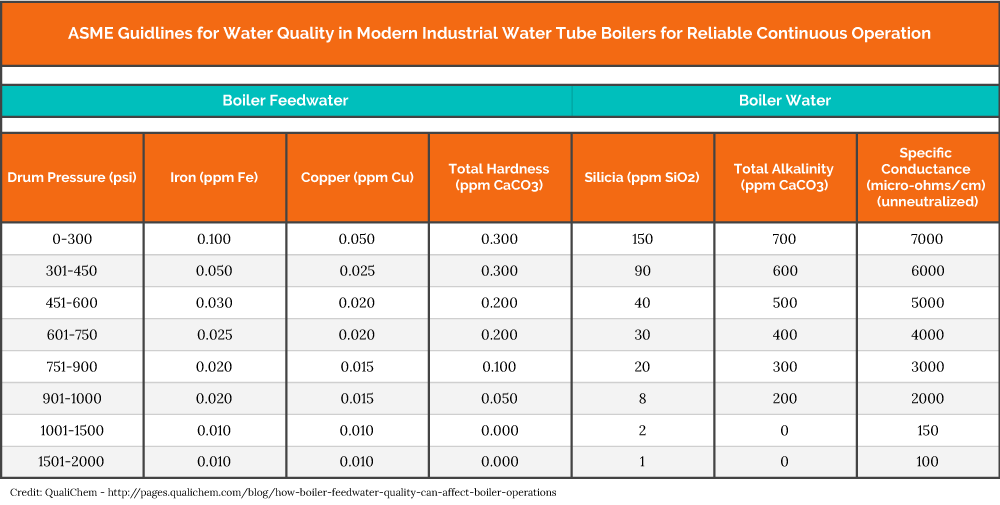
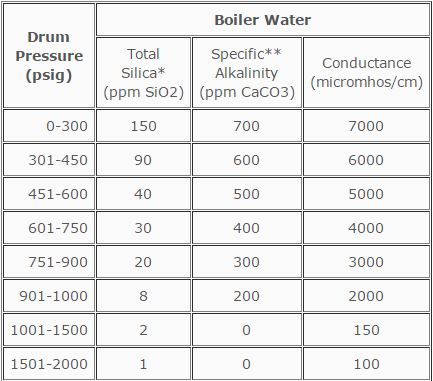
Asme limits conductivity 7000 umhos neutralized.
Conductivity control in the boiler.
For boiler water the conductivity increases at the rate of approximately 2 of the value at 25 c for every 1 c increase in temperature.
Total hardness 1 ppm maximum.
Some impurities such as hardness iron and silica are of more concern for example than sodium salts.
Phosphates are used to react with calcium hardness in the boiler water.
A boiler water sample has an unneutralised conductivity of 5 000 μs cm at 25 c.
An increase in temperature results in an increase in electrical conductivity.
Presented by cleaver brooks steve connor.
A boiler that makes up 4000 gal day of water having 100 ppm of hardness has a potential of accumulating over 1000 pounds of scale per year.
Iron oxide is of particular concern in today s boiler water treatment programs.
Crystals form crystals from scale.
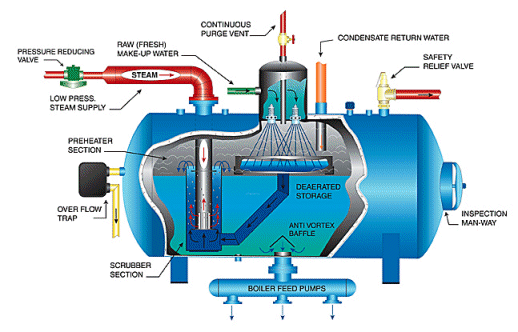
Feed water treatment to avoid corrosion make up water to steam boilers should be treated with oxygen scavengers to avoid serious corrosion problems.
It is desirable to keep the concentration of phosphates in the water to 30 50 ppm in order for complete reaction of the phosphates with the calcium hardness entering the.
73 control feed of chemicals that prevent scale.
Water treatment recommendations vary depending on the operating pressure of the boiler the application steam or hot water and other parameters.
Feed water purity is a matter both of quantity of impurities and nature of impurities.
Maximum flow velocities in water systems water velocities in pipes and tubes should not exceed certain limits.
Total alkalinity 600 ppm maximum.
Scale is a buildup of solid material formed on internal boiler surfaces when the concentration of impurities in the boiler water exceeds their solubility limit and precipitation occurs.